

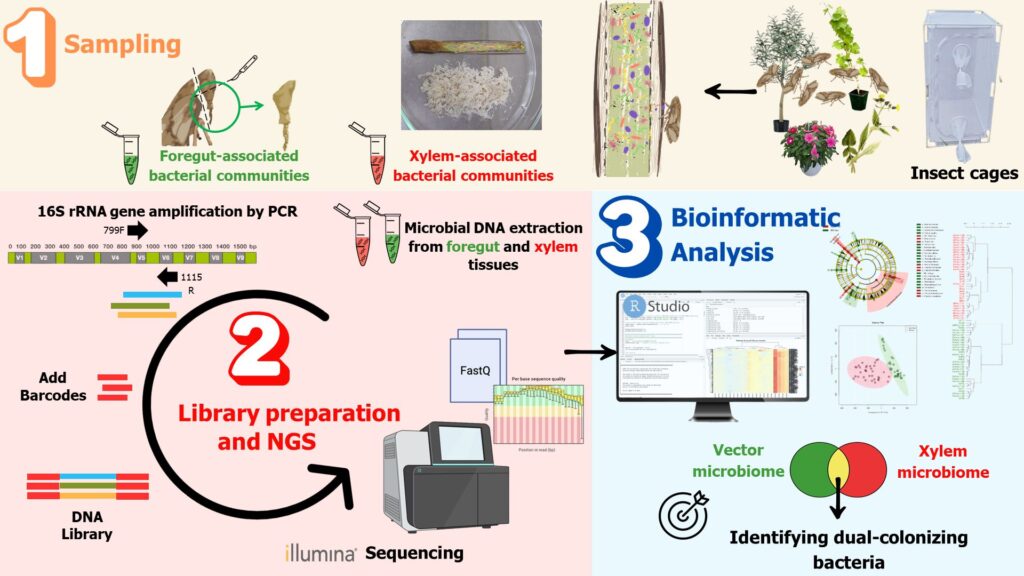
Deep within the xylem vessels of woody plants exists an unseen world of microbial life composed of diverse bacterial and fungal communities that coexist and interact with harmful vascular pathogens such as Xylella fastidiosa. When the meadow spittlebug (Philaenus spumarius), the main European vector of Xylella, feeds on xylem sap, it also ingests part of this hidden microbial community. Some of these bacteria manage to successfully establish in the insect’s foregut, just as X. fastidiosa does, where they may shape how the pathogen is transmitted.
Researchers from the “Phytopathology of Sustainable Agricultural Systems” group at the Institute for Sustainable Agriculture (IAS-CSIC, Córdoba, Spain) are exploring this microbial transfer in unprecedented detail in collaboration with researchers from the Institute of Agricultural Sciences (ICA-CSIC, Madrid, Spain). In their experiment, spittlebugs were confined in cages with different Xylella fastidiosa host plants: sow thistle (Sonchus oleraceus), periwinkle (Catharanthus roseus), olive (Olea europaea), and grapevine (Vitis vinifera). Insects were left to feed on the plants and sampled weekly to characterize the microbiota present in the insect’s foregut, while xylem sap from the plants was collected at the end of the experiment. Microbial DNA was extracted and analyzed using high-throughput 16S rRNA amplicon sequencing, comparing the communities associated with plants and insects through advanced bioinformatics.
Building on our earlier post, “From Spittlebug Guts to Plant Xylem: Discovering Superpowered Biocontrol Bacteria”, this comparative approach is revealing bacterial species that thrive in both plant xylem and the insect foregut. Such microorganisms could serve as “invisible allies,” competing with Xylella fastidiosa and limiting its ability to colonize plant xylem vessels and establish within the insect foregut. In the long term, this knowledge could inspire the development of new, eco-friendly ways to fight Xylella fastidiosa and protect Mediterranean woody crops from one of the greatest plant health threats of our time.