

We propose a novel strategy for controlling the vector‐borne bacteria Xylella fastidiosa by selecting symbiotic microorganisms from its insect vectors that also possess biocontrol properties. Specifically, we hypothesize that the gut microbiome of Philaenus spumarius contains bacterial species capable of disrupting X. fastidiosa life cycle through mechanisms such as resource competition, production of antimicrobial metabolites, or inhibition of biofilm formation.
Within the TED BIOSTOP-XF project, we explored the Philaenus spumarius microbiome through a culture-based workflow, followed by genomic, phenotypic, and functional profiling of key isolates. Specimens were supplied by Prof. Alberto Fereres’s team (ICA-CSIC), whose expertise in rearing this Xylella fastidiosa vector was indispensable to our study.
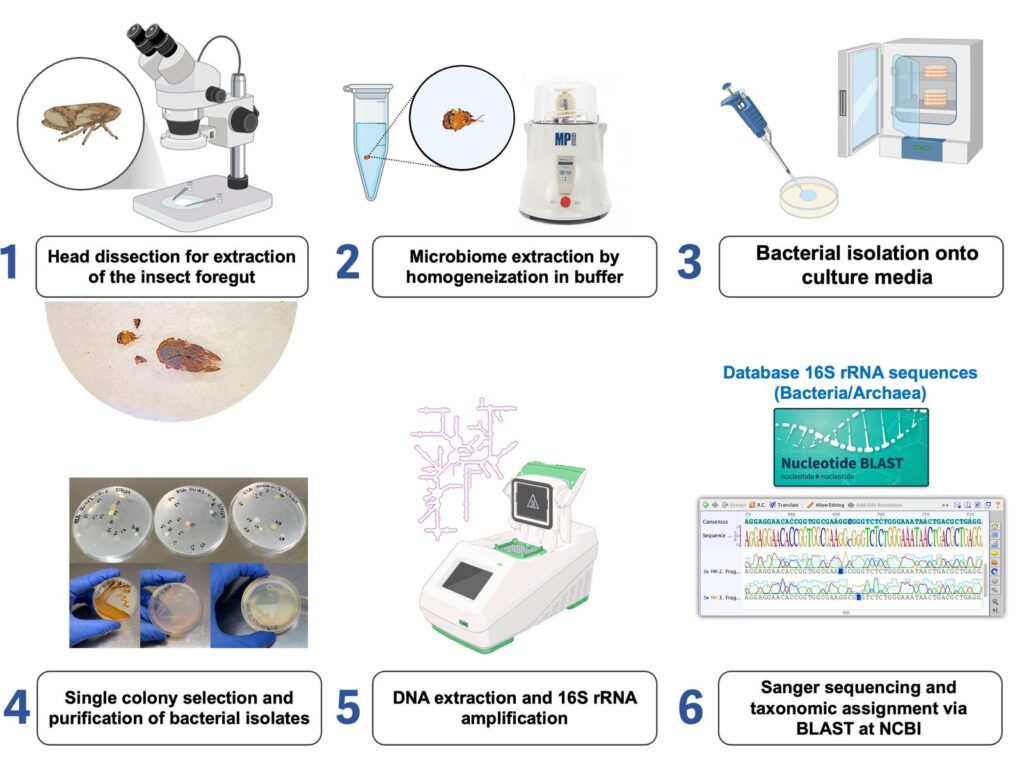
A streamlined protocol (Figure 1) was established at the Institute for Sustainable Agriculture (IAS-CSIC) to recover and identify foregut bacteria from the vector P. spumarius. Under sterile conditions, we dissected insect heads and isolated each foregut using a stereomicroscope. Tissues were homogenized in saline buffer with a cell disruptor, and the resulting suspension was serially diluted and spread onto Reasoner’s 2A (R2A) agar—a non-selective medium that supports diverse microbial growth. Plates were incubated at 28 °C, and emerging colonies were inspected daily. Morphologically distinct colonies were selected, re-streaked three times on fresh R2A to ensure purity, and then subjected to DNA extraction. We amplified the 16S rRNA gene by PCR, performed Sanger sequencing, and assembled high-quality contigs. Finally, we assigned taxonomy by querying each sequence against NCBI’s bacterial reference database using BLAST.
Applying this workflow, we successfully isolated and identified over 80 bacterial species spanning more than 50 genera from the foregut of P. spumarius. Notable genera include Methylobacterium, Burkholderia, Paraburkholderia, Curtobacterium, and Bacillus. These bacteria have also been described as xylem-inhabiting endophytes in key woody crops such as olive, grapevine, and citrus. This culture collection has been the focus of high-throughput genomic, phenotypic, and functional profiling to uncover biocontrol traits, including:
- Plant-growth promotion (e.g., phytohormone synthesis, nutrient solubilization)
- Antibiotic and enzyme production (e.g., chitinases, cellulases)
- Ecological competitiveness (e.g., motility, pili formation, rapid colonization)
- Resource competition (e.g., iron chelation, carbon-source utilization profiling)
The resulting functional profiles will guide the selection of candidate strains for targeted suppression of X. fastidiosa.
The holistic approach developed in this project has uncovered dual-habitat symbionts—bacteria that colonize both P. spumarius foreguts and plant xylem—with a suite of biocontrol traits, enabling them to target X. fastidiosa precisely at its two unique survival niches.