

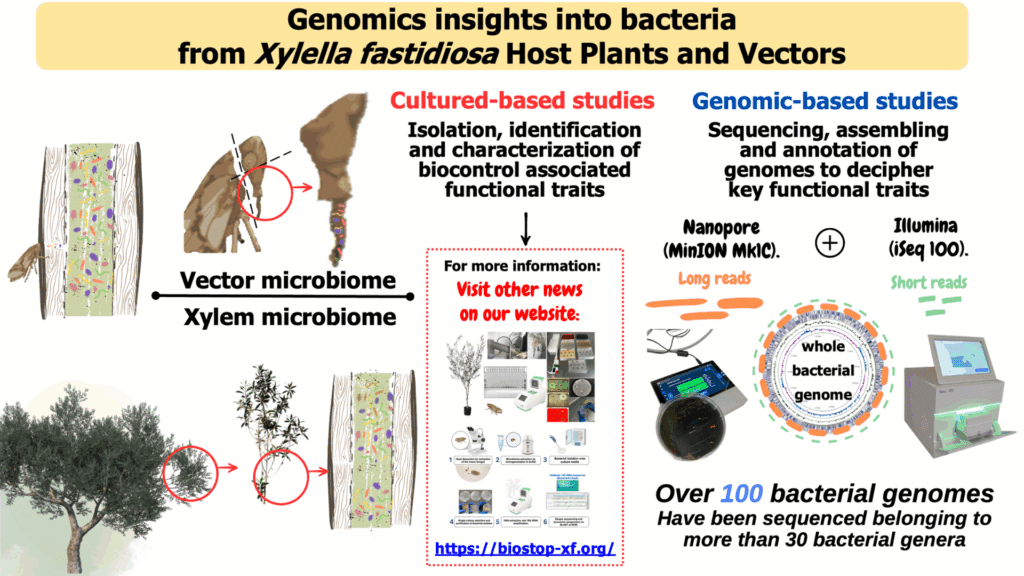
What secrets are hidden in the microbes that live inside the xylem of the plants and the insects that transmit Xylella fastidiosa?
At the “Phytopathology of Sustainable Agricultural Systems” research group at the Institute for Sustainable Agriculture (IAS-CSIC, Córdoba, Spain), we explore this microscopic universe by decoding the genomes of the most abundant bacteria found in various host plant species and in the foregut of Philaenus spumarius, the main vector of Xylella fastidiosa in Europe.
To achieve this, we use a hybrid sequencing strategy that combine two cutting-edge technologies:
- Oxford Nanopore (MinION Mk1C): generates long reads -like complete sentences although with some ‘errors’, that help piece together the overall structure of the genome.
- Illumina (iSeq 100 & Miseq): generates short, highly accurate reads -like error-free words- that correct mistakes and refine the genome.
By integrating both approaches, we obtained genomes that are not only structurally complete but also highly precise.
Why this matter?
Sequencing the genomes of the bacteria associated with host plants and the insect vectors of Xylella fastidiosa may provide critical insights into how these bacteria adapt to different environments, evade plant defenses, and persist in the insect’s foregut. Such knowledge may aid to develop targeted strategies to control diseases caused by this bacterium and improve crop health.
This research builds on our previous study From Spittlebug Guts to Plant Xylem: Discovering Superpowered Biocontrol Bacteria, where we investigated the functional potential of these bacteria. Now, we take the next step: decoding their complete genomes can help to understand how they move between plants and insects, and how they may influence plant health and pathogen transmission.
The journey continues. Genomics is revealing hidden worlds that could transform the way we protect crops and ecosystems.