

Beneficial bacteria are powerful allies in crop protection, boosting plant growth and naturally suppressing pathogens like Xylella fastidiosa. But what if we combine strains with complementary beneficial traits? That’s where synthetic bacterial communities (SynComs) come in — defined mixes of strains with complementary traits tested together.
By assembling SynComs from complementary strains (e.g., growth promoters plus antimicrobial producers), researchers may lay the groundwork for next-generation plant-protection products. But before that, we need to understand community behavior: How do these members interact? Do they cooperate, compete, or change how they colonize the plant when they’re together?
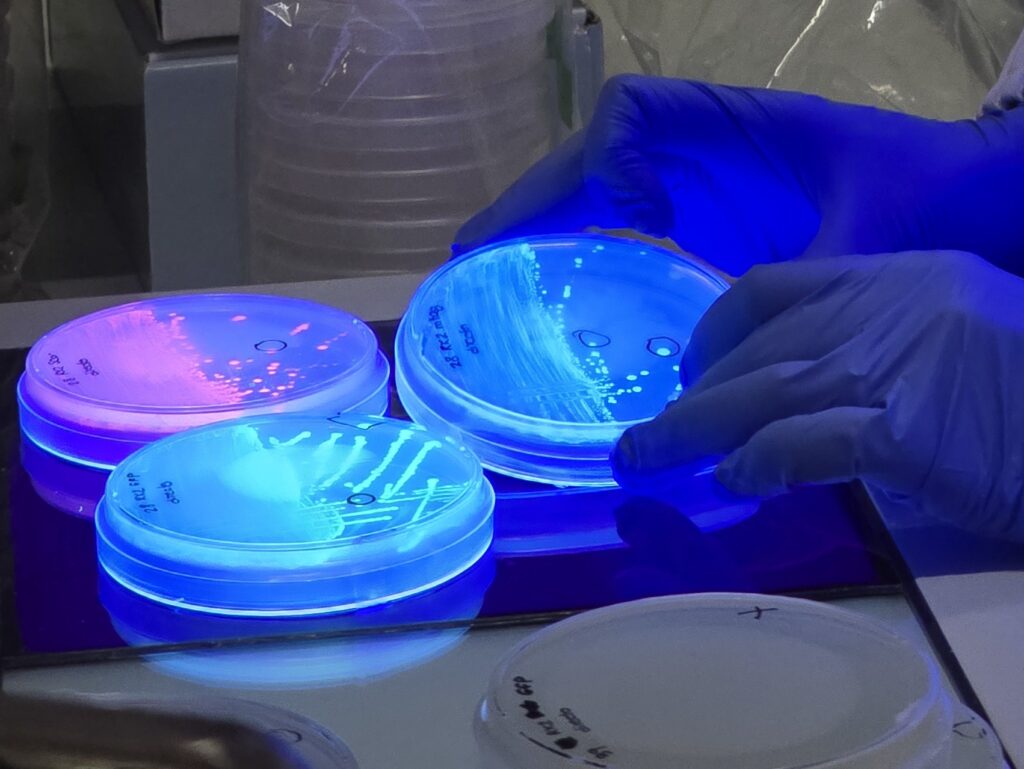
To answer these questions, scientists from the “Phytopathology of Sustainable Agricultural Systems” group at the Institute for Sustainable Agriculture (IAS-CSIC) in Córdoba, Spain, as part of BIOSTOP-XF project, are using an innovative—and surprisingly colorful—approach: they label (color) the bacteria to track them in the lab and greenhouse.
Although it may sound simple, “coloring” bacteria requires precise and sophisticated lab techniques. Researchers use bacterial conjugation —a mechanism for direct cell-to-cell transfer of small circular DNA molecules (plasmids)— to introduce genetic material encoding fluorescent proteins. The tagged strains then “glow”, and can then be visualized and tracked in mixed cultures and plant tissues.
Here’s how it works: scientists use a lab strain of Escherichia coli that carries a plasmid encoding a fluorescent protein (red, blue, green, or yellow). Under controlled lab conditions, this E. coli (the donor) is brought into contact with the beneficial bacterial strain. If conjugation succeeds, the plasmid transfers to the target bacterium (the recipient), which then begins producing the fluorescent protein.
The result: a SynCom whose members glow in different colors, allowing researchers to track members individually and monitor how they colonize plants and interact—in the lab and in greenhouse.
These experiments are key to designing well-balanced, effective SynComs that work together to protect crops. By understanding how beneficial microbes behave as a community, researchers move one step closer to creating eco-friendly, microbial-based solutions against devastating plant diseases, including those caused by X. fastidiosa.